

New DAR Radars
The new Radar generation proposed by Virtualabs, based on Digital Array Radar (DAR) technology, does not require a large amount of TRMs and is the technology that all modern radar will utilize.
With DAR technology it is possible to realize very cost-effective S Band MFR based on 4 fixed AESA antenna faces and X Band Fire Control Radar.
With just small changes it is possible to realize many types of MFR suitable for Tactical MFR
(e.g. SEADAR-F, SEADAR-C and LANDAR-P), Fire Control Radar (e.g. FCR-50X, DAR-X) or small Anti-Drone System (e.g. LANDAR-C/S, ADR-1/2) or even strategic Early Warning Radar (e.g. HPR 470).
Since there is no more a rotating search antenna, Virtualabs developed also a non-rotating IFF interrogator antenna, called CESA32.

Naval DAR Radars
SEADAR FAMILY


SEADAR-C /
SEADAR-F
SEADAR is a 4 Fixed AESA Faces Naval 4D S-Band MFR with for Surface/Air Surveillance and anti ship Gun guidance.
SEADAR-C is a version of S-Band Multifunction Radars family based on DAR Technology with 4 fixed faces of advanced Digital AESA antennas. SEADAR-C is a 4D (i.e. 4 Dimensions) radar, since, beside the range and the azimuth, it can measure instantaneously also the elevation and the speed of the detected targets
• Instrumental Range: up to 150 Km (Seadar-F) or up to 250 Km, (Seadar-C) programmable..
ADR FAMILY


ADR-1 (Compact)
ADR-1 is one of the most cost-effective Counter-Drone Radars available on the market.
It can be configured with 1 S-VBR/Face and 4 Fixed Faces
ADR-1 Main performances are:
• Range min= 0.1 Km
• Detection Range
• Target of 0.001 sqm (micro drones) up to 1.5 Km
• Target of 0.01 sqm (small drones) up to 3 Km
• Target of 1 sqm (big-drones) up to 10 Km
ADR-2 (Smart)
ADR-2 is a low-cost Counter micro/mini Drones radar composed of 4 Fixed Faces with 2 S-VBR/Face
Suitable for fixed and mobile-transportable installation.
ADR-2 can detect any size of drones at very long distance thanks to its advanced performances
ADR-2 target capabilities, compared with the ADR-1, become:
•Range min= 0.1 Km
•Detection Range
•Targets of 0.001 sqm (micro-Drones) up to 4 Km
•Targets of 0.01 sqm (small-Drones) up to 8 Km
•Targets of 1 sqm (big-Drones) up to 26 Km

IFF ANTENNA


CESA-32
Non-rotating IFF Interrogator PESA AntennaVirtualabs, for exigence of realization of modern requested naval architecture of a single superstructure (mast) with integration of radar and telecommunication fixed faces antennas, has projected a modern IFF-SSR antenna of:circular mechanical configurationcapabilities of electronic rotation-scan-pointingelectronic PESA configuration for utilization of legacy interrogator military IFF or air traffic SSRThe first antenna configuration – named CESA-32 – has dimensions defined for some actual naval application, but is easy realize antennas with different mechanical dimensions for application in different project of naval superstructures
Main Technical characteristics:
• Suitable for all modern interrogators IFF Mk-XIIA and SSR ICAO
• Horizontal Sum Beam: 12°
• Vertical Beam: 40°
• 1024 beam positions
• Sum & Difference Beams
• Easy Installation
• Weight: 20 + 20 + 15 Kg
FIRE CONTROL RADAR
FCR-50X
Virtualabs has developed, with same technology of S-VBR, a different own module, called X-VBR, with Digital Processing based on SoCs (System on Chips) working in X Band.
This module is the core of Virtualabs Fire Control Radar called FCR-50X. With large FOV (Field Of View) both in azimuth and elevation) allows to keep under tracking up to 4 threats simultaneously with very high accuracy. It can be offered eventually with auxiliary E/O sensors.
Main Performances:
• Long Range (On Design. up to 75 Km; Autonomous. Search up to 50 Km)
• Accurate Target Tracking ( Range 5 m; Angles < 1 mrd)
• AESA Antenna with electronic beam steering (+- 45° Az; > 100° El)
• AESA Antenna installed on an Azimuth Positioner to cover 360°
• Antinodding (against multipath)
• Shell-Splash (anti Ship Firing)
• Scartometry (Anti Air Firing)
• Multiple Target Tracking (Saturation problem mitigation)
• SWIR TV (Option)
• Easy Installation and Long MTBF

COMBINED MFR AND FIRE CONTROL RADAR


Air Defense Radars
LANDAR FAMILY

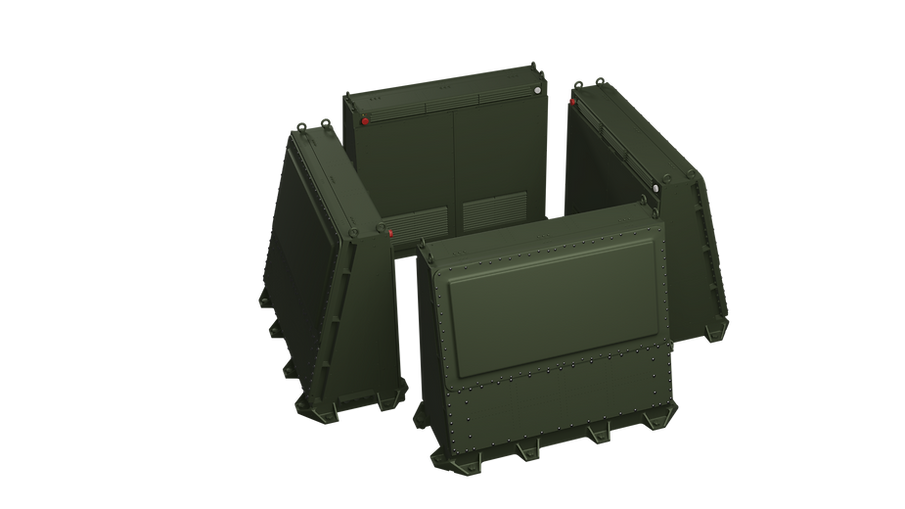
LANDAR-B (Basic) /
LANDAR-P (Performing)
With the same technical characteristics of SEADAR-C, LANDAR-P is Multifunctional Radar working in S-Band designed for Land application especially for a full Short Range Air Defence (SHORAD) function.
LANDAR-P is the Compact version of 4D MFR, based on 4 fixed faces of advanced Digital AESA antennas radars family of Virtualabs.
LANDAR-P is a 4D (i.e. 4 Dimensions) radar since, beside the range and the azimuth, it is able to measure instantaneously also the elevation and the speed of the detected targets.
LANDAR-P works in S Band, the best frequency band for Search Radars.
Each digital AESA Face (Digital Antenna Unit; DAU) is composed of 8 standard modules, called Virtualabs BRicks (VBR), i.e. antenna “tiles” composed, in turn, of 16 transmitting-receiving elements. The VBRs utilize Gallium Nitrate technology (GaN) to generate the RF radiated power.
LANDAR-B (Basic) differs from LANDAR-P (Performing) only in terms of use of VBRs, using 4 instead of 8.
LANDAR-S
(Smart)
LANDAR-S is a low-cost Anti micro/mini drones radar composed of 4 Fixed Faces with 2 S-VBR/Face
Suitable for fixed and mobile-transportable installation.
LANDAR-S can detect any size of drones at very long distance thanks to its advanced performances
Landar-S is configured also with 2 S-VBR/Face and 4 Fixed Faces. In this configuration the target capabilities becomes
•Targets of 0.001 sqm (micro-Drones) up to 4 Km
•Targets of 0.01 sqm (small-Drones) up to 8 Km
•Targets of 0.1 sqm (mini-Drones) up to 14 Km
•Targets of 1 sqm (big-Drones) up to 26 Km
•Targets of 2.0 sqm (Large-Drones) up to 33 Km


LANDAR-C
(Compact)
LANDAR-C (C stands for Compact) is one of the most cost-effective anti-drone Radars available on the market.
It is composed of 4 Fixed Faces with 1 S-VBR/Face
Main performances
•Range min= 0.1 Km
•Detection Range
•Target of 0.001 sqm (micro drones) up to 1.5 Km
•Target of 0.01 sqm (small drones) up to 3 Km
•Target of 1 sqm (big-drones) up to 10 Km

FIRE CONTROL RADAR
DAR-X

•DAR-X is a Fire Control Radar working in the X band.
•DAR-X exploits a Digital AESA antenna. All the connections between the Radar Processor and the AESA are digital.
•DAR-X solution foresees the beam steering performed ELECTRONICALLY. Therefore, no elevation mechanical movements.. In azimuth, the mechanical rotation is only used to get the designated target in the electronically covered sector. Once the beam is directed in the designated azimuth, the target tracking is performed pointing the beam electronically both in azimuth and in elevation.

LONG RANGE SURVEILLANCE RADAR


ADVANCED AIR TRAFFIC CONTROL RADAR
SKYDAR


SKYDAR is composed by 4 DAR Units connected by an e/o fiber cable to radar processing unit composed of very few digital boards ensuring a very high availability and low production cost. Many are the proprietary software that ensure SKYDAR good performances
In particular, the Clutter Cancellation function used in SKYDAR, based on the spectrum analysis, is very effective and without the losses of staggered MTI.